OGEA-103 Actual Test & OGEA-103 Exam Reviews
Wiki Article
BONUS!!! Download part of ActualCollection OGEA-103 dumps for free: https://drive.google.com/open?id=19_EbRnwd_E66FTVhZ-if9Aw6zSQif8S0
It means you can use the TOGAF Enterprise Architecture Combined Part 1 and Part 2 Exam (OGEA-103) PDF version of ActualCollection anywhere at any time on the smart device you have. Our team of professionals continuously updates the collection of The Open Group OGEA-103 PDF Questions according to changes in the real test's content. Due to these regular updates, you will get a better experience.
The Open Group OGEA-103 (TOGAF Enterprise Architecture Combined Part 1 and Part 2) Certification Exam is a globally recognized certification for enterprise architects. TOGAF Enterprise Architecture Combined Part 1 and Part 2 Exam certification exam combines both Part 1 and 2 of the TOGAF Enterprise Architecture framework. The TOGAF framework is a widely used approach for developing and managing enterprise architecture. It provides a common language, methodology, and tools for enterprise architecture development and management.
The TOGAF framework is widely used in the industry and is considered a leading framework for enterprise architecture. It provides a clear and structured approach to building and managing enterprise architectures. This framework helps architects to align their organization's business goals and objectives with its IT strategy, while also helping to reduce costs and increase efficiency.
OGEA-103 Exam Reviews | OGEA-103 Valid Test Registration
The OGEA-103 practice materials are a great beginning to prepare your exam. Actually, just think of our OGEA-103 practice materials as the best way to copyright is myopic. They can not only achieve this, but ingeniously help you remember more content at the same time. It is estimated conservatively that the passing rate of the exam is over 98 percent with our OGEA-103 Study Materials as well as considerate services. We not only provide all candidates with high pass rate study materials, but also provide them with good service.
The Open Group OGEA-103 (TOGAF Enterprise Architecture Combined Part 1 and Part 2) Certification Exam is a comprehensive exam that tests the knowledge and skills of enterprise architects. TOGAF Enterprise Architecture Combined Part 1 and Part 2 Exam certification is highly regarded in the industry and is recognized globally as a standard for enterprise architecture. OGEA-103 Exam covers both Part 1 and Part 2 of the TOGAF 9.2 standard, allowing candidates to demonstrate their understanding of the entire framework.
The Open Group TOGAF Enterprise Architecture Combined Part 1 and Part 2 Exam Sample Questions (Q135-Q140):
NEW QUESTION # 135
Complete the sentence The Architecture Landscape is divided into levels known as__________________________.
- A. Gaps Plateaus, and Target Architectures
- B. Transitional Complete and incremental Architectures
- C. Baseline. Transition and To Be Architectures
- D. Segment Strategic and Capability Architectures
Answer: D
Explanation:
The Architecture Landscape is divided into levels known as Segment Strategic and Capability Architectures. These levels correspond to different scopes and purposes of architectures within an enterprise. Segment Architectures are architectures that address specific business units, functions, or processes within an enterprise. Strategic Architectures are architectures that provide a high-level view of the enterprise's vision, goals, and direction. Capability Architectures are architectures that address specific business capabilities or services that span multiple segments or domains. Reference: The TOGAF® Standard | The Open Group Website, Section 2.4 Architecture Repository.
NEW QUESTION # 136
What is used to structure architectural information in an orderly way so that it can be processed to meet stakeholder needs?
- A. A Stakeholder Map
- B. An EA Library
- C. Content Metamodel
- D. An Architecture Framework
Answer: C
Explanation:
A content metamodel is a formal structure that defines the types of entities and relationships that are used to capture, store, filter, query, and represent architectural information in a way that supports consistency, completeness, and traceability12.
A stakeholder map is a tool that identifies and analyzes the key stakeholders and their interests, influence, and expectations in relation to the architecture3. It is not used to structure architectural information, but rather to understand the stakeholder needs and concerns.
An architecture framework is a set of principles, guidelines, standards, and tools that provide a common structure and methodology for developing architectures4. It is not used to structure architectural information, but rather to guide the architecture development process and ensure alignment with the business strategy and objectives.
An EA library is a repository that stores and manages the architecture artifacts, deliverables, and other relevant information produced and consumed during the architecture development and governance. It is not used to structure architectural information, but rather to provide access, security, and version control for the architecture content.
NEW QUESTION # 137
Please read this scenario prior to answering the question
You are working as Chief Enterprise Architect at a large Internet company. The company has many divisions, ranging from cloud to logistics. The company has grown rapidly, expanding from initially selling physical books and media to a range of services including an online marketplace, live-streaming. eBooks. and cloud services.
Overall management of the numerous divisions has become challenging. Recent high-profile projects have overrun on budget and under delivered, damaging the company's reputation, and adversely impacting its share price. There is a widely held view within the executive management that the organization structure has played a major role in these project failures.
The company has an established Enterprise Architecture program based on the TOGAF standard, sponsored jointly by the Chief Executive Officer (CEO) and Chief Information Officer (CIO). The CEO has decided that the company needs to reorganize its divisions around artificial intelligence and machine learning with a focus on automation. The CEO has worked with the Enterprise Architects to create a strategic architecture for the reorganization, including an Architecture Vision, together with definitions for the four domain architectures. This sets out an ambitious vision of the future of the company over a three-year period. This includes a set of work packages and includes three distinct transformations.
The CIO has made it clear that prior to the approval of the detailed Implementation and Migration plan, the EAteam will need to assess the risks associated with the proposed architecture. He has received concerns from key stakeholders across the company that the proposed reorganization may be too ambitious and there is doubt whether it can produce sufficient value to warrant the risks.
Refer to the scenario
You have been asked to recommend an approach to satisfy these concerns. Based on the TOGAF Standard, which of the following is the best answer?
- A. Before preparing the detailed Implementation and Migration plan, the Enterprise
- B. The Enterprise Architects should bring together information about potential approaches and produce several alternative target transition architectures. They should then investigate the different architecture alternatives and discuss these with stakeholders using the Architecture Alternatives and Trade-offs technique. Once the target architecture has been selected, it should be analyzed using a state evolution table to determine the Transition Architectures. A value realization process should then be established to ensure that the concerns raised are addressed.
- C. The Enterprise Architects should evaluate the organization's readiness to undergo change. This will allow the risks associated with the transformations to be identified, classified, and mitigated for. This should include identifying dependencies between the set of changes, including gaps and work packages. It will also identify improvement actions to be worked into the Implementation and Migration Plan. The business value, effort, and risk associated for each transformation should be determined.
- D. Establishing interoperability in alignment with the corporate operating model will ensure risks are minimized. The Enterprise Architects should apply an interoperability analysis to evaluate any potential issues across the architecture. This should include the development of a matrix showing the interoperability requirements. These can then be included within the transformation strategy embedded in the target transition architectures. The Enterprise Architects should then finalize the Architecture Roadmap and the Implementation and Migration Plan.
Answer: C
Explanation:
Architects should review and consolidate the gap analysis results from Phases B to This will identify the transformations required to achieve the proposed Target Architecture. The Enterprise Architects should then assess the readiness of the organization to undergo change and determine an overall direction to address and mitigate risks identified. The Transition Architecture should then be planned to use a state evolution table.
Explanation:
The Business Transformation Readiness Assessment is a technique that can be used to evaluate the readiness of the organization to undergo change and to identify the actions needed to increase the likelihood of a successful business transformation. This technique can help to address the concerns of the key stakeholders about the risks and value of the proposed reorganization. The technique involves assessing the following aspects of the organization: vision, commitment, capacity, capability, culture, and communication. Based on the assessment, the risks associated with the transformations can be identified, classified, and mitigated for. The technique also helps to identify the dependencies between the set of changes, including gaps and work packages, and the improvement actions to be worked into the Implementation and Migration Plan. The technique also supports the determination of the business value, effort, and risk associated for each transformation, which can be used to prioritize and sequence the work packages and the Transition Architectures1 Reference: 1: The TOGAF Standard, Version 9.2, Part III: ADM Guidelines and Techniques, Chapter 27: Business Transformation Readiness Assessment
NEW QUESTION # 138
Consider the following ADM phases objectives.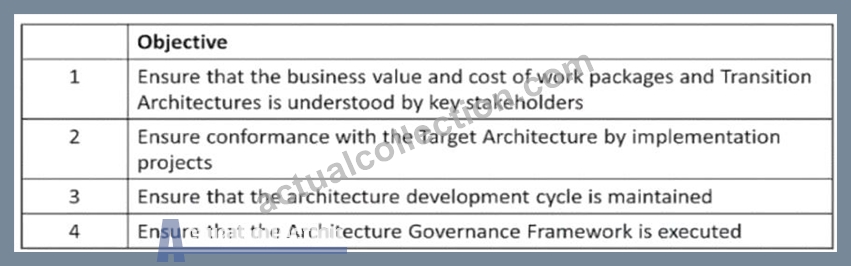
Which phase does each objective match?
- A. 1F-2G-3G-4H
- B. 1G-2H-3H-4F
- C. 1H-2F-3F-4G
- D. 1F-2G-3H-4H
Answer: C
Explanation:
According to the TOGAF Standard, Version 9.2, the ADM phases and their objectives are as follows1:
Preliminary Phase: To prepare and initiate the architecture development cycle, including defining the architecture framework, principles, and governance.
Phase A: Architecture Vision: To define the scope, vision, and stakeholders of the architecture initiative, and to obtain approval to proceed.
Phase B: Business Architecture: To describe the baseline and target business architecture, and to identify the gaps between them.
Phase C: Information Systems Architectures: To describe the baseline and target data and application architectures, and to identify the gaps between them.
Phase D: Technology Architecture: To describe the baseline and target technology architecture, and to identify the gaps between them.
Phase E: Opportunities and Solutions: To identify and evaluate the opportunities and solutions for implementing the target architecture, and to define the work packages and transition architectures.
Phase F: Migration Planning: To finalize the implementation and migration plan, and to ensure alignment with the enterprise portfolio and project management.
Phase G: Implementation Governance: To provide architecture oversight and guidance for the implementation projects, and to manage any architecture change requests.
Phase H: Architecture Change Management: To monitor the changes in the business and technology environment, and to assess the impact and performance of the architecture.
Requirements Management: To manage the architecture requirements throughout the ADM cycle, and to ensure alignment with the business requirements.
Based on the above definitions, we can match each objective with the corresponding phase as follows:
Objective 1: Ensure that the business value and cost of work packages and transition architectures is understood by key stakeholders. This objective is achieved in Phase H: Architecture Change Management, where the value realization and cost-benefit analysis of the architecture are performed2.
Objective 2: Ensure conformance with the Target Architecture by implementation projects. This objective is achieved in Phase F: Migration Planning, where the conformance requirements and criteria for the implementation projects are defined3.
Objective 3: Ensure that the architecture development cycle is maintained. This objective is achieved in Phase F: Migration Planning, where the architecture roadmap and iteration cycle are maintained3.
Objective 4: Ensure that the Architecture Governance Framework is executed. This objective is achieved in Phase G: Implementation Governance, where the architecture governance processes and procedures are applied to the implementation projects4.
References:
1: The TOGAF Standard, Version 9.2, Chapter 5: Architecture Development Method (ADM)
2: The TOGAF Standard, Version 9.2, Chapter 21: Architecture Change Management
3: The TOGAF Standard, Version 9.2, Chapter 20: Migration Planning
4: The TOGAF Standard, Version 9.2, Chapter 19: Implementation Governance
NEW QUESTION # 139
Consider the following statement:
According to the TOGAF Standard a governed approach of a particular deliverable will ensure a system of continuous monitoring to check integrity changes decision-making and audit of all architecture-related activities Which deliverable is being referred to?
- A. The Architecture Vision
- B. The Architecture Definition Document
- C. The Statement of Architecture Work
- D. An Architecture Contract
Answer: D
Explanation:
Explanation
An Architecture Contract is a deliverable that specifies the responsibilities and obligations of the parties involved in the implementation and governance of an architecture. It ensures a system of continuous monitoring to check integrity changes decision-making and audit of all architecture-related activities.
Reference: The TOGAF Standard | The Open Group Website, Section 3.3.4 Architecture Contracts.
NEW QUESTION # 140
......
OGEA-103 Exam Reviews: https://www.actualcollection.com/OGEA-103-exam-questions.html
- 100% Pass Quiz The Open Group OGEA-103 Marvelous Actual Test ???? Go to website { www.prepawaypdf.com } open and search for 「 OGEA-103 」 to download for free ????OGEA-103 Training Pdf
- OGEA-103 - Pass-Sure TOGAF Enterprise Architecture Combined Part 1 and Part 2 Exam Actual Test ???? Download ⇛ OGEA-103 ⇚ for free by simply entering ➤ www.pdfvce.com ⮘ website ????Test OGEA-103 Lab Questions
- OGEA-103 - Pass-Sure TOGAF Enterprise Architecture Combined Part 1 and Part 2 Exam Actual Test ???? Download ➤ OGEA-103 ⮘ for free by simply searching on ⮆ www.prepawaypdf.com ⮄ ????OGEA-103 Trustworthy Exam Torrent
- OGEA-103 - Pass-Sure TOGAF Enterprise Architecture Combined Part 1 and Part 2 Exam Actual Test ???? Download ➡ OGEA-103 ️⬅️ for free by simply entering ▛ www.pdfvce.com ▟ website ????Free OGEA-103 Study Material
- 100% Pass Quiz The Open Group OGEA-103 Marvelous Actual Test ???? Download ➠ OGEA-103 ???? for free by simply searching on “ www.practicevce.com ” ????Latest OGEA-103 Test Answers
- The Best OGEA-103 Actual Test - Leader in Certification Exams Materials - Fantastic OGEA-103 Exam Reviews ???? Search for “ OGEA-103 ” and download it for free immediately on ➥ www.pdfvce.com ???? ↪Free OGEA-103 Study Material
- Efficient OGEA-103 Actual Test | Pass-Sure OGEA-103 Exam Reviews and Trusted TOGAF Enterprise Architecture Combined Part 1 and Part 2 Exam Valid Test Registration ???? Copy URL ⇛ www.examcollectionpass.com ⇚ open and search for ⏩ OGEA-103 ⏪ to download for free ????OGEA-103 Training Pdf
- Pass Guaranteed 2026 OGEA-103: Unparalleled TOGAF Enterprise Architecture Combined Part 1 and Part 2 Exam Actual Test ???? Open website ▶ www.pdfvce.com ◀ and search for ☀ OGEA-103 ️☀️ for free download ????Valid Test OGEA-103 copyright
- Get Excellent Marks in One Go with The Open Group OGEA-103 Real Dumps ???? Search for ➡ OGEA-103 ️⬅️ and obtain a free download on ➥ www.practicevce.com ???? ????New OGEA-103 Study Notes
- 100% Pass Quiz The Open Group OGEA-103 Marvelous Actual Test ???? Easily obtain ⏩ OGEA-103 ⏪ for free download through ⏩ www.pdfvce.com ⏪ ????Current OGEA-103 Exam Content
- OGEA-103 Training Pdf ⛄ New OGEA-103 Study Notes ⬛ OGEA-103 Exam Bootcamp ???? Simply search for ⇛ OGEA-103 ⇚ for free download on ✔ www.examcollectionpass.com ️✔️ ????Latest OGEA-103 Test Pdf
- barryjmmm168587.wikiusnews.com, jeanoyui317897.onzeblog.com, royfonx061006.blogrelation.com, stayindirectory.com, aprilyucf399217.ourcodeblog.com, susanxajn640206.daneblogger.com, estelleotoc664215.bloggactif.com, www.stes.tyc.edu.tw, tekskillup.com, www.stes.tyc.edu.tw, Disposable vapes
What's more, part of that ActualCollection OGEA-103 dumps now are free: https://drive.google.com/open?id=19_EbRnwd_E66FTVhZ-if9Aw6zSQif8S0
Report this wiki page